
For nearly two decades, I’ve worked with search technology. I’ve helped companies build and optimize Elasticsearch clusters, troubleshoot performance problems, and scale search systems to handle enormous amounts of data.
I still think Elasticsearch is one of the most important infrastructure technologies of the past 20 years. It made sophisticated search accessible to developers and changed how organizations work with data.
But I wouldn’t build the next generation of search engines the same way. And the reason isn’t simply that AI needs vector search. It’s that vector search is becoming a commodity, while the cost and complexity of retrieving information are becoming much bigger problems.
Almost every major database now offers some form of vector retrieval. PostgreSQL, MongoDB, Elasticsearch, and OpenSearch all support it. In November 2026, AWS even added hybrid keyword and vector search to S3 Vectors, its cost-optimized vector storage service.
That’s a remarkable shift. What was recently a differentiating feature is increasingly something developers expect to get by default. So if vector search itself is no longer enough to differentiate a product, where is the real opportunity? I believe it’s in building search infrastructure that can handle the next generation of workloads at a fraction of today’s cost.
AI Is Changing the Economics of Search
Traditional search applications typically serve human interactions. Someone enters a query, receives a list of results, and decides what to do next.
AI agents work differently.
A coding agent might retrieve documentation, search source code, inspect previous changes, and look up related errors before proposing a fix. A customer support agent might retrieve account information, product documentation, pricing rules, and previous incidents to answer one question.
A single task can generate dozens of retrieval operations across different kinds of data. Now multiply that across thousands of agents running continuously. Search stops being an occasional user interaction and becomes a recurring cost inside almost every AI workflow.
This creates a problem that I believe the industry is underestimating.
We’ve spent enormous effort optimizing AI inference costs: smaller models, better GPUs, quantization, caching, and more efficient serving. But what about the infrastructure that feeds those models the information they need?
There is little point in making inference dramatically cheaper if retrieving the context becomes an increasingly expensive part of every AI operation.
And this problem extends far beyond AI agents. Ecommerce, recommendation systems, security analytics, and enterprise applications all depend on efficient retrieval, often at enormous scale.
The Next Breakthrough Isn’t Another Vector Index
Much of the discussion around AI search has focused on vector databases and approximate nearest-neighbor algorithms. Those are important technologies, but they solve only part of the problem.
Real applications rarely ask a simple question such as “find the ten vectors closest to this one.” They ask more complicated questions, e.g. Find the most relevant documents, but only those belonging to this customer. Exclude anything the user isn’t authorized to access. Prioritize recent information. Match exact identifiers when necessary, combine semantic similarity with keyword relevance, and return results quickly.
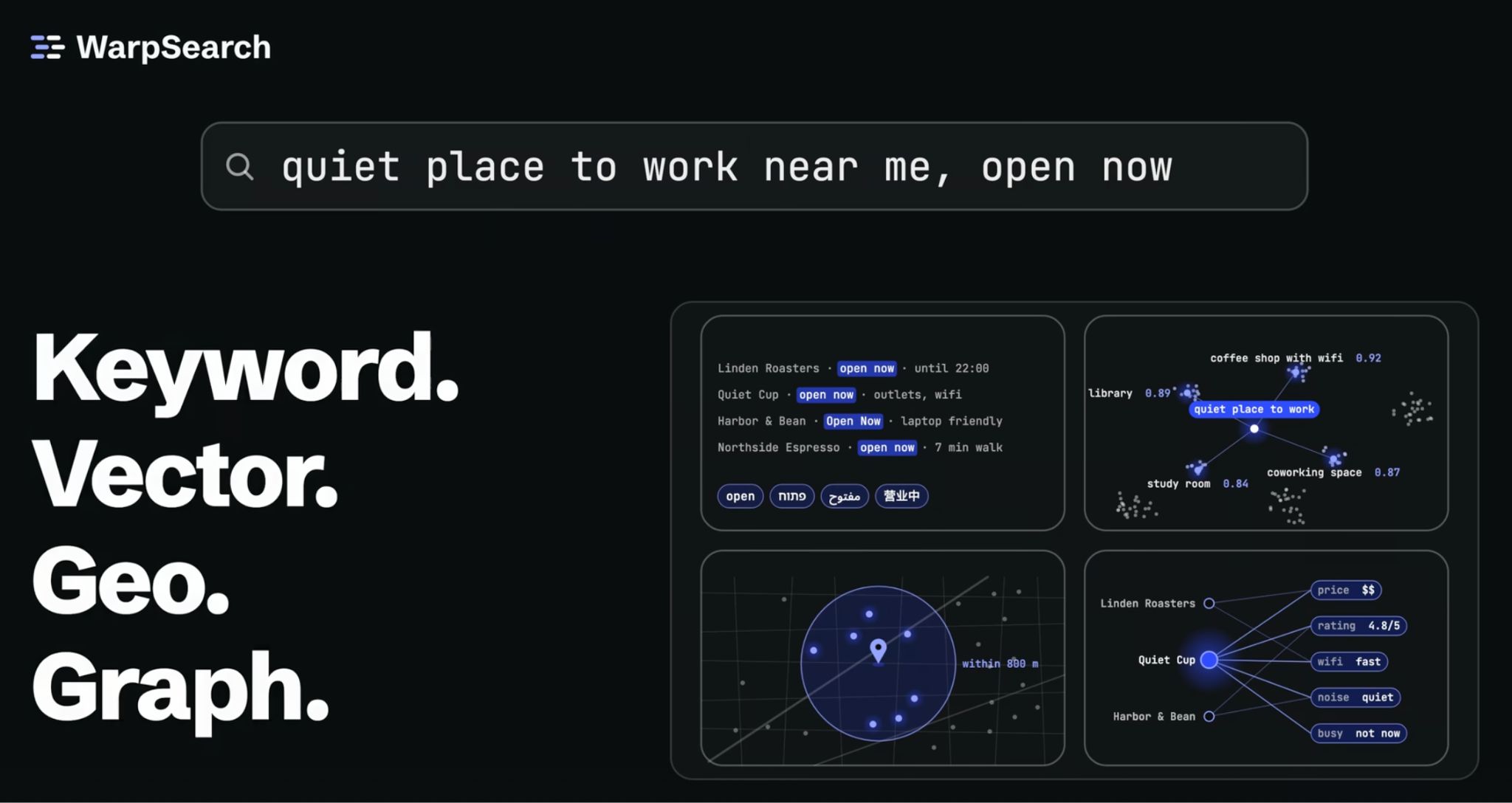
This is why hybrid search is becoming so important. Keyword matching, vector similarity, structured filtering, and ranking need to work together, not as unrelated systems stitched together at the application layer.
The challenge is no longer just supporting all these capabilities. It’s executing them efficiently, together, at scale.
Consider a collection containing hundreds of millions of documents. If a user’s permissions and filters reduce the relevant search space to a few hundred documents, why should we pay the cost of searching a massive global vector index? Sometimes the fastest and cheapest approach is to apply the filters first and scan a small subset directly.
The same principle applies to storage. A frequently queried collection with strict latency requirements may justify memory-resident indexes. A large collection searched a few times per day probably doesn’t. Yet traditional deployments often require organizations to provision infrastructure based on peak requirements, even when much of their data is rarely accessed.
HNSW, disk-based indexes, quantization, selective indexing, and object storage all have their place. The best approach depends on the workload.
The next generation of search engines should be designed to avoid unnecessary work, not simply execute more work faster. That means reconsidering which data needs indexing, which data belongs in memory, how queries are pruned, and when compute resources are needed at all.
Performance Per Dollar Matters More Than Performance Alone
There’s a reason this matters commercially. An engine can deliver impressive millisecond latency and still be far too expensive for its intended application. It can also offer incredibly cheap storage but become impractical when queries must return in single-digit milliseconds.
Neither extreme solves the problem.
The real question is how much it costs to deliver a successful retrieval at the required latency, relevance, and reliability. An independent benchmark published by Percona illustrates how much architecture matters. Testing six database engines with approximately one million vectors on the same host, Percona found that time to a queryable index ranged from 1.9 minutes to 6.7 hours. Index sizes ranged from 3.9 GiB to 15.1 GiB. Query performance also depended heavily on recall targets and concurrency.
That’s an extraordinary range for systems ostensibly providing the same fundamental capability. It also shows why comparing engines based on one headline latency number is inadequate. We need to evaluate the full workload: indexing, updates, filtering, memory consumption, query throughput, and the total cost of operating the system.
This becomes especially important as AI increases the number of retrieval operations applications perform. A small inefficiency repeated millions or billions of times is no longer small. And an architecture that eliminates unnecessary indexing, reduces memory requirements, or avoids paying for idle compute can change the economics of an entire application.
Why We Decided to Build Something New
This is the realization that ultimately pushed us to start building WarpSearch.
After years of optimizing Elasticsearch for customers, we kept encountering the same fundamental constraints. We could improve queries, adjust index configurations, optimize hardware, and reduce cluster costs.
But there were limits to how much we could change without changing the underlying architecture. That led us to ask a different question. What if we designed a search engine today, knowing what we now know about modern hardware, cloud infrastructure, vector retrieval, and AI workloads?
We decided to build a new engine in C++, with a focus on efficient query execution, aggressive pruning, optimized caching, and the ability to combine keyword and vector search without maintaining separate systems.
We also wanted storage and compute economics that didn’t require customers to maintain dedicated clusters simply to keep their data searchable.
Our initial results have been encouraging. In our own benchmarks, we’ve measured median keyword-search latency of approximately 2.4 milliseconds on 10 million text passages using modest hardware. Our published pricing models also suggest substantial potential savings for certain retrieval workloads.
These are our own measurements and models, not independent proof of superiority across production environments. There’s still considerable work required to validate a new engine across different workloads.
But the experience has reinforced something important. The opportunity isn’t simply to make Elasticsearch faster, or to create another vector database. It’s to challenge the assumption that sophisticated search must be expensive to operate.
Search Needs a New Economic Foundation
I don’t believe existing search engines are going away. Nor do I think every application needs a specialized vector database. For many applications, vector search inside PostgreSQL or another existing database may be perfectly adequate. Adding another system would only introduce unnecessary complexity.
At the other end of the market, established search platforms continue to offer sophisticated capabilities that new engines must work hard to match. But between these extremes, and increasingly at large scale, there’s a growing need for something different.
Applications need full-text and vector retrieval, complex filtering, high throughput, low latency, and predictable operating costs. They need to scale without paying for resources they aren’t using. That’s a much more meaningful problem to solve than simply adding support for another indexing algorithm. And it’s where I believe the next significant search infrastructure companies will emerge.
AI is changing how much information software needs to retrieve, how frequently it retrieves it, and how complex those operations are becoming. The demand for search will grow. The pressure to make every retrieval cheaper will grow with it.
The winners won’t necessarily be the companies with the fastest vector indexes or the longest feature lists. They’ll be the ones that can deliver relevant results, reliably and at scale, with the least amount of work and infrastructure.
After nearly two decades spent optimizing search engines, that’s the problem I believe is worth rebuilding them to solve.