

The Cisco Catalyst brand has been making its mark on the world of networking for many years. I can think back to when the first switches were sent out in road cases for trials. As the product itself has evolved, so has all the technologies around it. The demands are higher, the speeds are faster, and we can build an entire building with Power-over-Ethernet.
Inside the Catalyst portfolio there’s been a consistent trend when it comes to putting the numbers 50 in the product name. Sometimes it’s a step upgrade, but several times the “50” represents the flagship in capabilities. There are likely a few readers here that are thinking back to their favorite “50” that they learned on.
The Cisco Catalyst 9350 Smart Switch, recently introduced at Cisco Live, is the latest “50” and it packs a punch. Not a punch in how fast it is, but how it’s designed to deliver mission-critical power infrastructure. The Tech Field Day Extra presentation from Kenny Lei, Technical Marketing Engineer at Cisco, went into detail on the new platform.
The future of real estate and building management is clearly based on the power infrastructure that can be provided. The thought process is pivoting, and the conversation is getting close to the pure discussion of delivering power first, data second. Lighting, Security, AV, IoT, Collaboration, USB-C ports, and now Displays are all in direct need of efficient and resilient DC power infrastructure. The conversion overload can stop.
The focus from Cisco on power infrastructure management sets the Catalyst apart from the competition in interesting ways. Power infrastructure is not something to mess lightly with. From switches becoming a fire hazard, to underrated power supplies, it’s frequently possible to end up with not enough power to effectively do the things needed.
StackPower+ is available with the Catalyst 9350 and it’s a 55V power-sharing architecture that allows the stack of power supplies to act as one load. The stack gets redundancy, efficiency, and real-time demand sharing. By adding just one power supply to the stack the capacity is increased for all members. Now that all switch stacks are expected to always deliver 60-90W on all ports, the numbers ramp up fast on power supply needs. Up to four of the Catalyst 9350 switches can be connected in a StackPower+ ring.
A single Catalyst 9350-48HX has a total PoE budget of 4320 watts. With power delivery now reaching new heights this is the highest power budget in the industry. The Catalyst 9350 supports three hot-swappable power supplies. It’s also nice that the new default configuration for the 9350-48HX ships with a 1600-watt power supply. If the project is calling for the 48HX then the power discussion is alive and well. The heat generated in this solution can be very high and the 3 hot-swappable fans are welcome.
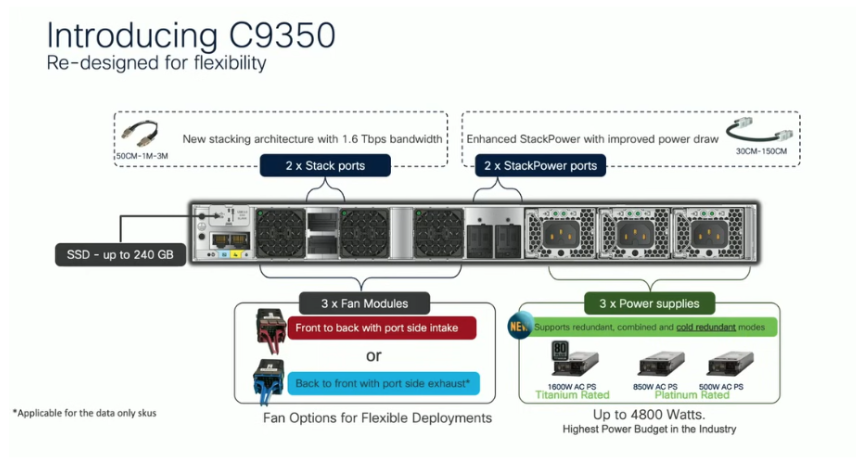
At this point, you may be wondering why we’re still talking about power and how that relates to the title of this article. To put it simply, how often are you replacing power infrastructure? The more things that we all keep adding to the PoE conversation, then it’s less likely you’ll be swapping that out. It’s a strategy and commitment to head down this path in power distribution and companies are loving the change. Reporting, energy savings, and alternative fuels are all included when discussing the next real estate project. While we’re here we can also talk about reduction of copper usage. Do you need AC in all spaces?
This Catalyst 9300 “50” series will be around a long time as it rolls into refreshes and new builds throughout the world. Smart buildings will be built using Cisco Catalyst as a power delivery foundation and the refresh cycles will increase dramatically. We’re entering this new era where the discussion isn’t just about networking. It’s about doing it better than we ever have before.
The full Tech Field Day video introducing the Cisco Catalyst Smart Switches is available on YouTube at Introducing Cisco C9000 Series Smart Switches.