

Modern data center networks are no longer just the concern of IT departments – they’re a strategic business asset. As highlighted in Futurum Research’s The Modern Data Center Network Checklist infographic, the first category of requirements is Business Requirements, which focus on reliability, scalability, and total cost of ownership (TCO) alignment. These three priorities have emerged as non-negotiable for IT leaders and business decision-makers shaping next-generation networks. Here’s why each is critical and how they impact network design and operations.

Reliability: Foundation of Business Continuity
Network reliability has risen to the top of the agenda for modern data centers. In fact, 86% of organizations rank reliability as the #1 criterion for their next network, outranking even integration and operational ease. This priority is driven by the severe business consequences of downtime. A recent survey conducted by Futurum Research found that an hour of data center network downtime would cause critical internal disruptions for 80% of organizations, with 74% fearing major customer-impacting outages and 68% expecting significant revenue loss. In short, unreliable networks put business operations, customer trust, and revenue at risk.
These stakes explain why reliability is viewed not as a trade-off but as the foundation for all other objectives. Business leaders now assume the network will “support constant change, deliver predictable performance, and recover from failures without noticeable impact.” Achieving this means designing for maximum uptime and resilience. Modern data centers build in high availability through redundant paths, failover mechanisms, and robust disaster recovery plans.
They also emphasize quality and testing in network hardware and software – as our checklist notes, a focus on reliability-driven hardware and Network Operating System (NOS) design with rigorous production-level testing is key. This focus addresses real-world pain points; nearly three-quarters of organizations report encountering networking software bugs that require emergency patches. By demanding rock-solid network operating systems and devices, businesses mitigate the risk of outages caused by technology failures. Ultimately, reliability isn’t just an IT metric – it’s a business continuity imperative that underpins customer experience and corporate reputation.
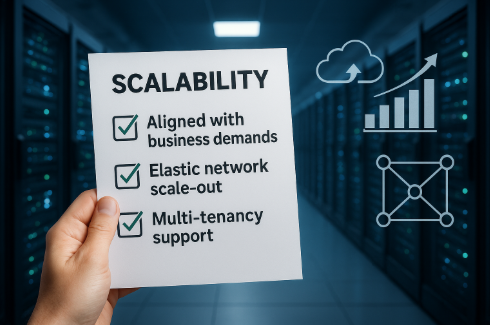
Scalability: Aligning with Business Growth and Agility
Hand-in-hand with reliability is scalability – the ability of the network to grow and adapt seamlessly as business demands evolve. In the era of cloud computing, AI, and digital business, data center networks must accommodate constant growth in traffic and rapid shifts in workloads. The checklist infographic stresses scalability as being “aligned with business demands,” enabling elastic network scale-out and multi-tenancy support for growing environments. This reflects a strategic priority: data center networks should never become the bottleneck to expansion or innovation.
Modern architectures embrace designs that make scaling out easier and more cost-effective. The de facto standard approach is the spine-leaf Clos fabric, where capacity can be added horizontally by introducing new leaf or spine switches, rather than forklift upgrading a whole chassis. Networking technologies like virtualization and overlay networks (e.g. EVPN-VXLAN) also contribute to scalability, allowing new tenants to be deployed logically without redesigning the physical network. Indeed, technologies have matured to make “high availability [and] dynamic scaling… more achievable and more cost-effective” today. This means even as data center traffic grows exponentially or new services come online, a well-designed network can flex and absorb the change.
Scalability is not just about raw bandwidth (though that is important – over half of surveyed leaders are already prioritizing next-gen 800 Gbps and 1.6 Tbps port speeds in their planning). It’s also about geographic and architectural scale. Many enterprises now operate hybrid data center infrastructure, with 79% running on-premises data centers while 65% also use public cloud. The network must scale across these environments, connecting multiple sites and clouds as one cohesive fabric. Multi-tenancy features (like VRFs and segmentation) ensure that scaling to accommodate new business units, customers, or applications doesn’t compromise security or performance isolation. In summary, a scalable network infrastructure gives businesses the agility to pursue new opportunities – whether that’s launching in new markets, handling seasonal traffic spikes, or adopting cutting-edge AI and data analytics workloads – confident that the network can keep up with demand.

TCO Alignment: Cost-Efficient Networking at Scale
The third business requirement, TCO alignment, recognizes that networks must deliver all the above – reliability and scalability – in a cost-efficient manner. Total cost of ownership alignment means designing and operating the network with cost optimization in mind, to achieve business goals without overspending. This priority has grown as companies seek to balance ambitious digital initiatives with fiscal responsibility. In practice, aligning the network to TCO objectives involves minimizing expensive manual efforts, reducing errors (which lead to costly downtime), and leveraging modern innovations to lower both capital and operating expenses.
One major strategy for TCO alignment is increasing automation in network operations. By automating routine tasks, organizations reduce labor costs and avoid human errors that could trigger outages. Industry research indicates that network automation “reduces the total cost of ownership by preventing expensive errors, reducing downtime, and lowering maintenance overhead.” The result is not only savings on support hours, but also more reliable service delivery – a win-win for cost and performance. It’s no surprise that ease of operations (74%) and automated operations (70%) ranked among top decision criteria for new data center networks. These figures highlight how closely operational simplicity and cost efficiency are intertwined; a network that is easier to run is ultimately less costly to run.
Another aspect of TCO alignment is leveraging cost-effective technologies. The rise of merchant silicon in switches and routers – high-performance, commodity chipsets – has driven down the cost per gigabit of networking. Many modern data centers are built with “white box” switches and a modern NOS, which can be more economical than proprietary legacy systems while still meeting performance needs. The widespread use of IP and Ethernet standards also lowers integration costs. In fact, ease of integration was the #2 criteria (82%) for new networks, reflecting that businesses want solutions that play nicely with existing systems to avoid expensive integration projects. Designing with open standards and interoperable components means avoiding vendor lock-in and enabling use of competitive, budget-friendly options over time – again improving TCO over the network’s lifecycle.
Finally, aligning to TCO means continually measuring and justifying network investments in business terms. Forward-looking IT teams track metrics like cost-per-transaction or revenue protected by network uptime. This ensures that reliability and scalability enhancements also make economic sense. When network teams can demonstrate that a more reliable, scalable architecture reduces downtime costs and enables new services, it reframes the network from a cost center to a business enabler. In the end, a modern data center network must be reliable enough to support the business without interruption, scalable enough to fuel growth, and efficient enough to fit within financial constraints. Achieving this trio of business requirements is the cornerstone of any successful, modern network strategy.
Explore The Modern Data Center Network Checklist infographic for a visual summary of these business requirements and how they set the stage for architectural and operational priorities.
This blog post is number 1 in a series of 3. To see the other posts, visit: https://techstrong.it/category/sponsored/modern-dcn-checklist-blog-series/