

In the data center, planned maintenance is somewhat of a paradox. It’s essential for reliability, yet it often introduces the very risks it’s meant to prevent. Even brief upgrade windows can cascade into minutes of downtime, causing service disruption and financial loss. Even the notorious in-service-software-upgrade (ISSU) technology, which promised a seamless network device software upgrade, continues to give engineers anxiety.
The Nokia data center fabric reliability study developed by Nokia Bell Labs Consulting, provides extensive modeling and new data showing how Nokia SR Linux combined with Event-Driven Automation (EDA) redefines network maintenance, turning what used to be an operational headache into a predictable, nearly invisible process.
The report compares legacy, manual maintenance workflows under the Present Mode of Operation (PMO) against modern, automated ones under a Future Mode of Operation (FMO) powered by SR Linux and EDA. The results show that enterprises adopting this architecture experience up to 96% reduction in downtime and achieve over five nines (99.999%) availability, translating to only a few minutes of unplanned downtime per year.
The Challenge of Network Maintenance
In most data centers today, maintenance operations such as firmware/software or hardware upgrades require manual coordination. Network engineers need to isolate devices, drain traffic, and hope that failover behaves correctly. The process introduces multiple risks including configuration drift, synchronization errors, and inconsistent traffic rerouting. Even well-planned upgrades can trigger a temporary service degradation or outage.
The Bell Labs modeling found that traditional PMO environments incur significant downtime during these planned events due to failover delays and protection errors, typically instances when redundancy fails to work properly. These weaknesses directly impact operational costs, SLA penalties, and, ultimately, can degrade the customer experience.
Use Case

Device Upgrade and Traffic Drain
EDA addresses this long-standing challenge through intelligent automation. When upgrading a network device and performing a preemptive traffic drain, EDA provides built-in capabilities to ensure network reliability during maintenance. Before an upgrade or reboot, the platform gracefully drains traffic from affected devices, rerouting flows across alternate paths without packet loss. The network device is then placed into maintenance mode, effectively quarantined from live traffic, ensuring that service continuity is maintained throughout the maintenance activity.
Once the device is idle in terms of traffic, EDA centralizes and streamlines the upgrade process. Instead of locking a router for the entire duration of the procedure, SR Linux allows the system to remain operational until the exact moment it is ready to reboot. This significantly reduces the actual maintenance window and limits exposure to operational risk.
Equally important, all upgrade steps are pre-tested in the EDA digital twin, a like-for-like virtual copy of the production network. In this environment, operators can validate the upgrade path, confirm configuration compatibility, and detect anomalies before executing the live change. The result is a maintenance process that is not only faster but measurably safer.
Quantified Reliability Gains
The report’s reliability modeling shows that these maintenance capabilities provided by EDA directly improve key parameters such as mean time to restore and protection error probability, both of which contribute to overall availability. In side-by-side comparison with legacy systems, the FMO architecture using SR Linux and EDA reduces planned-maintenance-related downtime by over 60%, and unplanned incident downtime by nearly 96%.
In business terms, this means fewer SLA violations and less revenue loss. Bell Labs estimates that organizations moving from PMO to an FMO with SR Linux and EDA can achieve up to 60% reduction in SLA penalties, 53% reduction in revenue loss, and up to 44% reduction in reputational damage due to improved operational stability.
Real-World Efficiency
Consider an enterprise data center preparing for a critical software upgrade across hundreds of spine switches. Using legacy methods, engineers might stagger updates over days or weeks, manually verifying each stage and monitoring for anomalies. With EDA, the upgrade process is centrally orchestrated, automatically sequencing device updates while maintaining live traffic elsewhere in the network. Using EDA in this way, traffic is drained, devices reboot, and service continues uninterrupted.
From Maintenance to Reliability Engineering
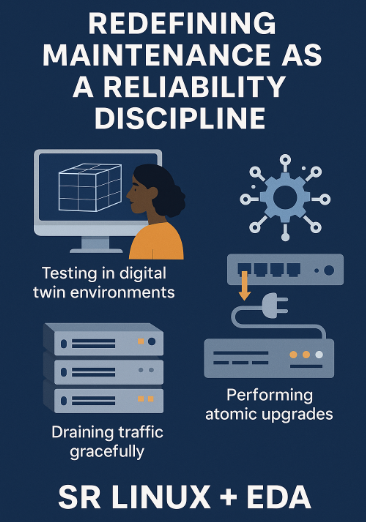
This shift represents more than automation. It’s a redefinition of maintenance as a reliability discipline. By embedding intelligence into every maintenance step, such as testing in digital twin environments, draining traffic gracefully, and performing atomic upgrades, SR Linux and EDA elevates maintenance from a reactive necessity to a proactive advantage.
As Bell Labs’ analysis concludes, operational transformation accounts for nearly 90% of total reliability gains achieved under FMO with SR Linux and EDA. In other words, the biggest improvements in uptime don’t come simply from hardware. Instead, they come from smarter operations.
With SR Linux and EDA, maintenance no longer means risk. Through automation, validation, precision orchestration, and network-wide instant restore from a known-safe baseline, networks can evolve continuously without compromising performance. For modern data centers where downtime carries six-figure costs per minute, that’s not just operational progress – it’s a competitive advantage.
This blog post is number 4 in a series of 4. To see the other posts, visit: https://techstrong.it/category/sponsored/blc-report-blog-series/
You can also find out more about the study here and read the executive summary here.