
TL;DR — Key Takeaways
- Multi-cloud connectivity uses services from multiple cloud providers and links them so data and applications can work together.
- Hybrid cloud combines public cloud services with private cloud or on-premises infrastructure.
- Multi-cloud can improve resilience, flexibility, provider choice and regulatory compliance.
- It can also reduce vendor lock-in and make future provider migrations easier.
- The trade-offs include greater operational complexity, harder data governance and a larger security attack surface.
- Multi-cloud is generally best suited to organizations with clear business needs and sufficient cloud expertise.
Cloud services are revolutionizing modern businesses. However, relying on a single cloud provider for your technology stack can be limiting. For greater flexibility and better performance, organizations increasingly look for multi-cloud connectivity.
What is Multi-Cloud Connectivity?
Multi-cloud is when businesses use multiple cloud providers to deliver services across their technology stacks. Often, this involves using software-as-a-service (SaaS), platform-as-a-service (PaaS), and infrastructure-as-a-service (IaaS) solutions from different providers.
However, simply using multiple cloud applications simultaneously provides less value. For data consistency and to unlock features such as automation, apps should communicate between cloud environments.
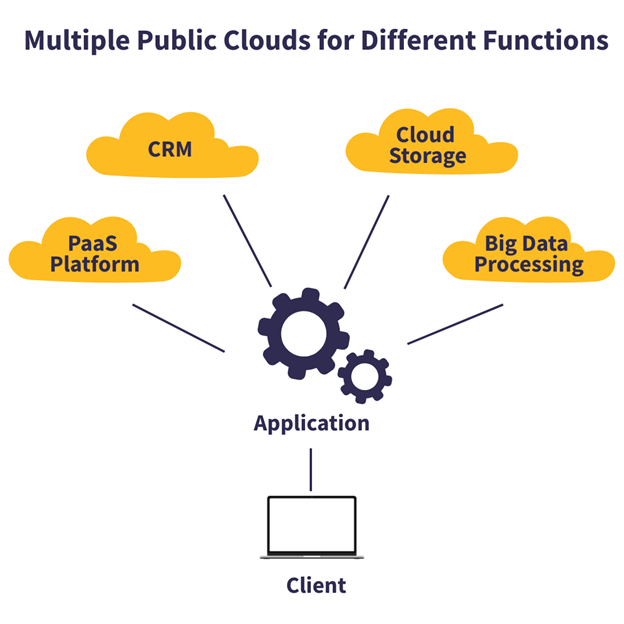
For instance, let’s imagine you are running a customer-facing application that uses multiple cloud platforms. You use Amazon Web Services (AWS) to power the main back end, Google Cloud to run data analytics workloads and Microsoft Azure for identity management.
These tools become even more useful when integrated. Data flows from the back end into Google Cloud for analysis, while Azure ensures authentication on all your platforms.
What is Hybrid Cloud?
A hybrid cloud integrates two or more forms of infrastructure. This could be a combination of an on-site data center or a private cloud (or both), with a public data center.
Organizations choose hybrid clouds for a variety of reasons. Hybrid clouds help improve compliance, as sensitive information can be stored on private clouds or on-site servers, improving data security.
Another advantage of a hybrid cloud is scalability. As your needs grow, you can ramp up cloud-based capabilities without needing to invest in any new hardware.
It should be noted that hybrid clouds and multi-clouds aren’t necessarily separate solutions. A multi-cloud can also function as a hybrid cloud.
The Pros and Cons of Multi-Cloud Networking
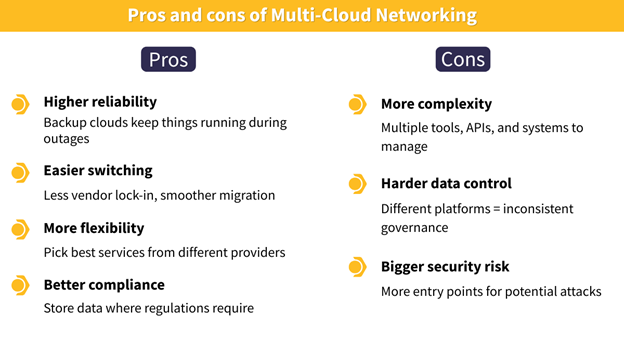
Multi-cloud networking can bring many benefits to your business. However, this solution isn’t right for all organizations. We’ve listed some of the pros and cons below to help you make a more informed decision.
Pros
Improved Reliability and Reduced Downtime
With a single-cloud approach, you risk losing access to all services in the event of an outage. Customers might not be able to carry out important conversions, such as signing up for your site or making a purchase.
A multi-cloud approach increases redundancy. If one cloud experiences downtime, other clouds will continue to run. This means you’ll still be able to benefit from some (albeit reduced) functionality.
Easier Migration Between Providers
Vendor lock-in is a bigger problem with a single-cloud approach. When infrastructure and functionality are offered by a single provider, switching vendors is a significant effort.
For instance, when all your information is in one place, migrating becomes a bigger challenge, as transferring data can be highly expensive. Organizations often stick with their current providers simply to avoid the expense.
Switching vendors is often easier with a multi-cloud approach. There’s less upheaval, as you’re swapping one aspect of your existing infrastructure.
Greater Flexibility and Choice
With a single-cloud provider, you’re reliant on the services within a provider’s ecosystem. While providers often offer flexibility, you’re still limited to the options on offer.
Multi-cloud connectivity gives the option to pick and choose between providers to find a solution that closely fits your needs. You can also distribute applications strategically across different clouds to improve performance and reduce costs.
For example, many organizations are adopting secure access service edge (SASE) to bring networking and security into a single, unified service. Here, one provider handles security and another deals with networking. This helps to ensure the best possible network performance and security.
Easier Regulatory Compliance
Data privacy legislation often mandates certain data handling practices, especially for highly regulated industries. For instance, the European Union’s General Data Protection Regulation (GDPR) requires data for EU citizens to be stored safely and securely. It puts certain restrictions on transferring information outside the EU.
Working with a single-cloud provider can make compliance more difficult. If your provider doesn’t offer EU data centers, you may need to lay additional safeguards in place to protect data.
With multi-cloud, you can choose a provider whose servers are located in the EU. This means fewer data transfers and easier compliance with EU law.
Cons
Increased Operational Complexity
Multi-cloud networking is often more complex than single cloud. All vendors are different, with a preference for certain APIs, dashboards and other varying factors. This requires more expertise to ensure coordination between apps. Cloud-native complexity can cause mistakes that lead to performance or security issues down the line.
This is less of a concern when working with a single provider. All apps use more consistent interfaces and tooling models. This allows organizations to set up more quickly with reduced scope for error.
More Challenging Data Governance
A single-cloud provider brings a unified approach to data governance. With multi-cloud, different cloud providers have their own methods of storage, managing databases and applying metadata and other cataloging information. This makes it harder to apply consistent data management policies across your organization.
Identity and access management (IAM) becomes equally challenging. Different IAM systems mean permissions often require manual remapping between cloud environments. This can make mapping policies a more complex process that often takes time and can lead to mistakes.
An Expanded Threat Landscape
A multi-cloud network potentially means a larger attack surface for cybercriminals compared to a single cloud.
As we’ve reflected, a multi-cloud approach can be more complex. Mistakes during integration can lead to vulnerabilities that attackers can exploit. What’s more, different firewall and networking configurations can create inconsistencies with your security policies.
Businesses will need to take additional steps to ensure a secure cloud-native architecture. Regular risk assessments combined with security management tools are needed to ensure a secure environment.
Is Multi-Cloud Right for You?
Multi-cloud connectivity brings many benefits to businesses. As we’ve explored, though, it also poses some potential challenges.
Ultimately, think about your business’ unique circumstances. If you’re a smaller business lacking in-house expertise, a single-cloud network might be the way forward. If you’re a larger organization, want to avoid vendor lock-in and have the necessary specialized teams, multi-cloud might be a strong option.
