Quantum computing has crossed an important threshold, but it is not the one the headlines usually suggest.
The market has arrived. The money, customers, government incentives, cloud services, acquisitions and corporate quantum programs are all real. The generally useful, fault-tolerant quantum computer they are preparing for is not.
Enterprise users spent approximately $300 million on quantum computing in 2025, exceeding spending by research laboratories and governments for the first time. Venture investment in quantum technology startups reached $12.6 billion. In May 2026, the U.S. Department of Commerce proposed more than $2 billion in CHIPS Act incentives across nine quantum companies, including investments in foundries, manufacturing and the supporting industrial base.
Those figures represent genuine economic activity. They do not represent proof of useful quantum advantage.
No enterprise today can purchase a quantum server, move a meaningful portion of its computing estate onto it and document a superior return. Most commercial programs still involve cloud access, algorithm development, proofs of concept, research partnerships, integration work or preparation for capabilities that remain on vendor roadmaps.
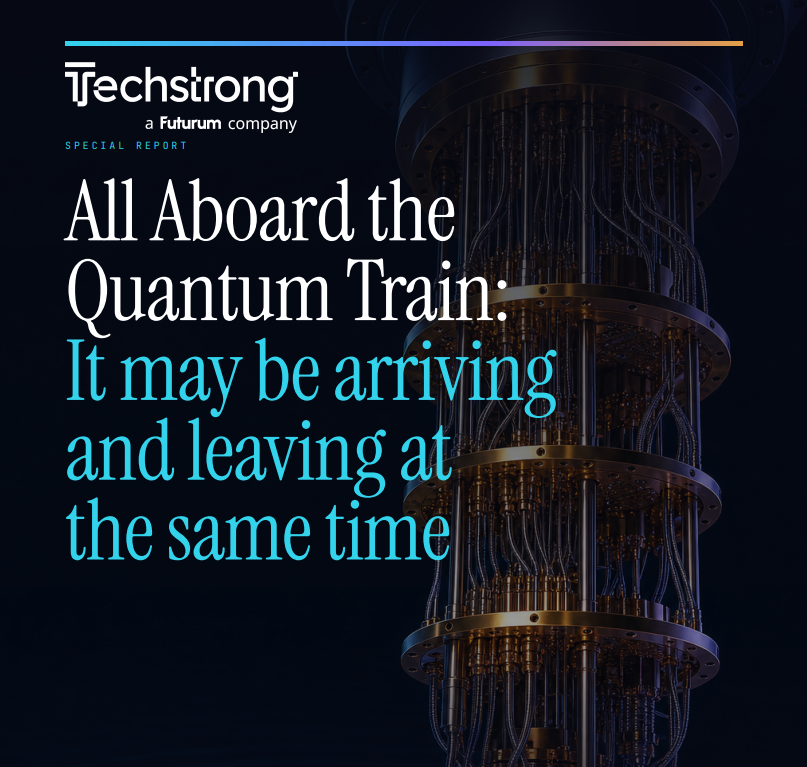
That contradiction is the subject of our new Techstrong Special Report, All Aboard the Quantum Train: It May Be Arriving and Leaving at the Same Time.
The report examines what has actually been demonstrated, what has been funded, what has only been promised and what enterprise leaders should do between now and the end of the decade.
One of the industry’s biggest problems is that five very different milestones are routinely presented as if they were the same achievement. Benchmark supremacy is not useful quantum advantage. Operating below the error-correction threshold is not fault tolerance. Producing a logical qubit is not the same as running a commercially valuable application. And selling access to a quantum processor does not prove that the processor can outperform the best available classical alternative.
All are legitimate signs of progress. None should be mistaken for the final destination.
The hardware landscape remains equally unsettled. Roughly 67 companies across 17 countries were manufacturing quantum processing units through ten modalities at the end of 2024. Superconducting circuits, trapped ions, neutral atoms, photons, silicon spins and topological approaches all make different tradeoffs among fidelity, speed, connectivity, manufacturability and operating complexity.
Quantum computing still has no transistor moment: no dominant architecture or broadly accepted manufacturing process around which the industry has converged. Consolidation has already begun, and it is almost certain that most of today’s QPU builders will not survive as independent companies.
AI adds another layer to the story. AI is already improving error decoding, calibration, circuit design and quantum simulation. GPU-based systems are becoming essential parts of quantum error correction and control. Quantum computing may eventually accelerate portions of AI, but today the relationship is decidedly asymmetric: AI is already helping build better quantum machines, while quantum acceleration of AI remains largely a research proposition.
The part of the quantum market that unquestionably has arrived is post-quantum cryptography. NIST has finalized standards, federal migration requirements are taking shape and organizations with long-lived sensitive information need to begin cryptographic discovery and transition planning now. That work does not depend on IBM, Microsoft, Quantinuum, IonQ or anyone else meeting a hardware roadmap.
For everything else, enterprises need a disciplined standard. A credible quantum result must identify the hardware used, disclose the classical computation surrounding it, compare against the best current classical alternative and measure improvement in cost, time, energy or accuracy. If the supposed advantage cannot be expressed in one of those terms, there may be no advantage to evaluate.
The future is unlikely to be a quantum computer replacing the data center. It is more likely to be a data center that knows when to call one.
The quantum train is in the station, but not every carriage is going to the same place, and several are still being built while passengers board. Our new report separates the arrivals from the departures and the engineering achievements from the commercial promises.
Download All Aboard the Quantum Train: It May Be Arriving and Leaving at the Same Time and read the complete Techstrong Special Report.