
TL;DR — Key Takeaways
– pgEdge launched Starfleet, a Postgres platform designed to let developers spin up a database in less than two minutes.
– Starfleet adds AI-focused capabilities including an MCP server, a retrieval-augmented generation API and copy-on-write database branching.
– Applications built on Starfleet can be deployed in self-hosted environments or on pgEdge’s cloud service without moving to a different database architecture.
pgEdge today made available an instance of its distribution of the open source Postgres database that is designed to enable application developers to set up a database in less than two minutes.
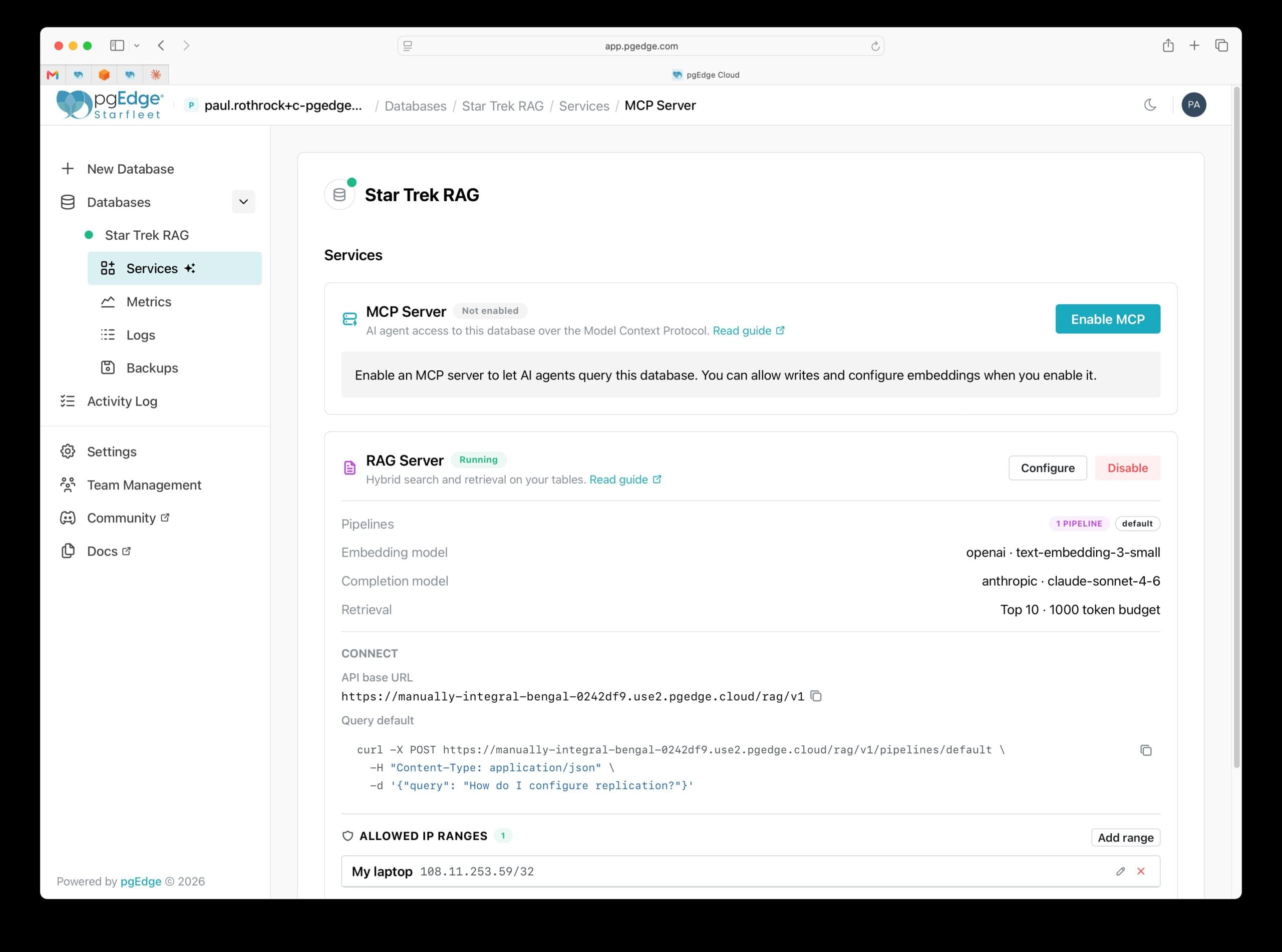
Company CEO Phillip Merrick said the pgEdge Starfleet database, in addition to providing an instance of Postgres that has been curated to provide a better developer experience, also includes multiple capabilities for building artificial intelligence (AI) applications, including a Model Context Protocol (MCP) server, an application programming interface (API) for retrieval augmented generation (RAG) and copy-on-write database branching.
Once developed, those applications can then be deployed in any type of self-hosted IT environment running an instance of the Postgres database or on the cloud service provided by pgEdge, noted Merrick. Rather than developers building applications on a document database, the goal is to provide developers with an instance of Postgres that is easily accessible to build applications that can then be deployed on the same database that many IT teams run in production environments, he added.
The pgEdge Starfleet database enables that capability because, unlike other providers of cloud services based on Postgres, the storage layer has not been replaced with a proprietary or semi-proprietary storage layer. Additionally, pgEdge has developed a real-time data synchronization capability that spans multiple instances of Postgres databases.
Finally, pgEdge Starfleet is designed to be secure because the default setting is not open to the Internet while a pgEdge SafeSession capability ensures MCP connections are read-only.
Historically, application developers have tended to build applications on the database platform that was most accessible. If and when that application might be ready to be deployed in a production environment, many IT teams would wind up having to migrate that application to the database already running in a production environment or, alternatively, add yet another database to the production environment. pgEdge is making a case for simplifying application development using a Postgres database that is already running in many of those production environments.
At the same time, it is adding AI capabilities that are rapidly becoming standard capabilities for any new application that organizations might build and deploy. That’s critical because AI agents that need to automate a task eventually need to access structured data that usually resides in a database, noted Merrick.
It’s not clear to what degree IT teams are moving to rationalize the number of databases they need to support, but as the pace of application development continues to accelerate in the AI era, there is now a pressing need to reduce as much as possible the friction that exists today within those workflows. As such, many IT teams are now being specifically tasked with improving the overall developer experience to eliminate bottlenecks that slow the pace of application deployment.
The challenge, as always, is not just defining a database standard, but also migrating any data that happens to reside in another platform to the new corporate standard that IT operations teams need to strictly enforce.