
TL;DR — Key Takeaways
- IBM has installed its first quantum computer in Illinois, deploying Quantum System Two at the University of Chicago’s Hyde Park Labs.
- The system uses IBM’s 120-qubit Nighthawk r2 processor, which the company says can execute up to 25 times as many circuits per second as its earlier Heron processors.
- The computer will support research into drug discovery, power grid optimization and high-energy physics through collaborations involving industry and academic partners.
IBM has unveiled a new quantum computer in Chicago, giving researchers access to its latest quantum hardware for experiments in areas like drug discovery and power grid optimization.
The IBM Quantum System Two is now operating at the University of Chicago’s Hyde Park Labs, where IBM, the university and Illinois officials introduced it on Nov. 6. It is IBM’s first quantum computer installed in Illinois and will serve as the main hardware platform for the National Quantum Algorithm Center, established in 2024 to bring together companies, universities and national laboratories to develop and test quantum algorithms for practical applications.
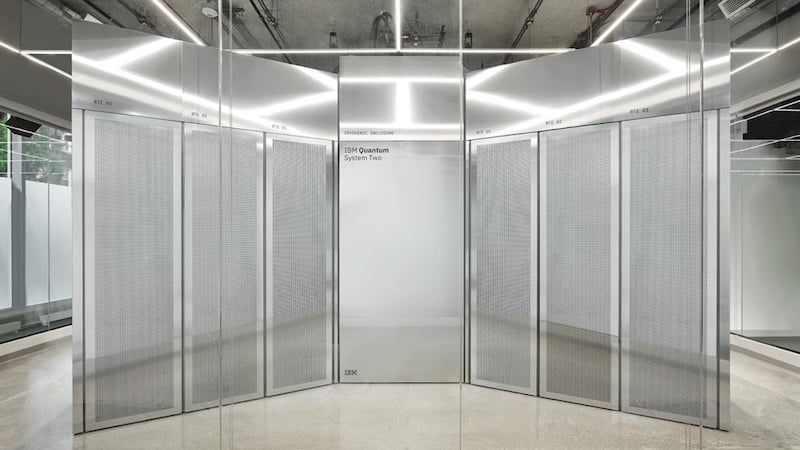
The IBM Quantum System Two (Image courtesy of IBM)
Inside the new system is IBM’s Nighthawk r2, a quantum processor with 120 qubits linked by 218 tunable couplers. The connections form a square lattice that gives most qubits four nearby neighbors to interact with. IBM introduced the Nighthawk processor in 2025 and announced the updated Nighthawk r2 in August. The newer chip uses faster qubit resets to execute up to 25 times as many circuits per second as IBM’s earlier Heron processors, according to the company.
The new machine will support several industry research projects already underway. IBM says AbbVie and Deloitte are working with IBM and Northwestern University on quantum molecular simulations for drug discovery. The Electric Power Research Institute and the University of Illinois Urbana-Champaign are exploring whether quantum algorithms could improve power grid efficiency. Fermilab is also collaborating with IBM on high-energy physics and distributed quantum computing.
In July, IBM and University of Chicago researchers reported achieving quantum advantage in an experiment involving 70 logical qubits. They completed a calculation in about 15 minutes that they said was beyond the practical capabilities of leading classical simulation methods. The experiment also introduced a method for assessing the reliability of the results, addressing a persistent challenge in quantum computing.
Hyde Park Labs will serve as the computer’s temporary home until the Illinois Quantum and Microelectronics Park is ready. The research campus, under construction on Chicago’s South Side, will eventually house both the computer and the National Quantum Algorithm Center. IBM has not announced a relocation date.
The Chicago installation is one of several major quantum developments IBM has announced this year. In September, its subsidiary Anderon finalized an agreement for up to $1 billion in federal funding under the CHIPS and Science Act to support quantum chip manufacturing research. That same month, IBM and Lockheed Martin announced plans for another Nighthawk r2-powered Quantum System Two in Switzerland, expected to become operational by the end of this year.