
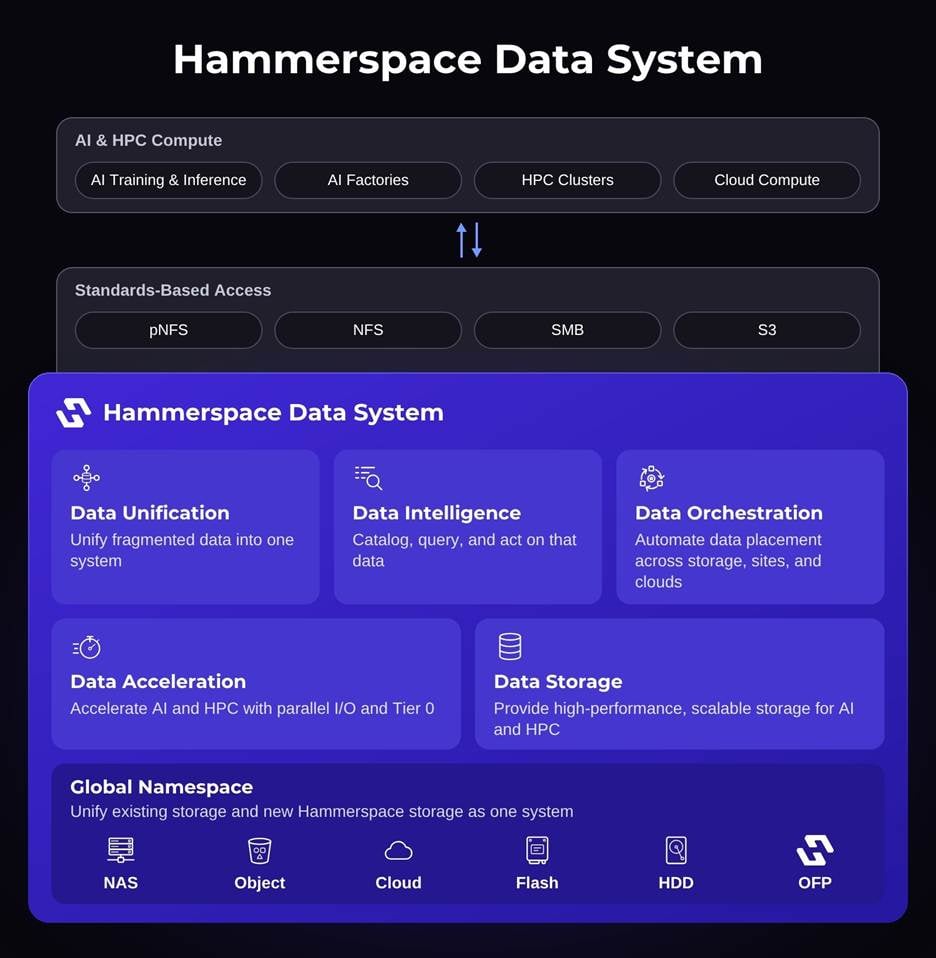
Hammerspace today at the Supercomputing 2026 conference added an integrated data and storage management platform, dubbed the Hammerspace Data System, that isolates metadata in a way that makes it possible to run artificial intelligence (AI) workloads more efficiently.
Additionally, Hammerspace has added the Hammerspace Open Flash Platform (OFP), a Flash-based storage platform that is based on data processing units (DPUs) to offload traditional servers. A KV cache running in memory also enables IT teams to create a Tier 0 level of storage that can be used to store context, such as AI skills.
Floyd Christofferson, vice president of product marketing for Hammerspace, said the goal is to enable parallel I/O throughput to ensure that the right data is exposed to various classes of AI workloads at the right time. An existing data orchestration capability then optimizes data placement across storage systems, data centers and cloud computing environments using a built-in global namespace that is based on a parallel file system. Previously, IT teams would have needed to acquire five different platforms to provide similar capabilities, noted Christofferson.
Removing conventional storage servers can reduce I/O bottlenecks and the need to overprovision infrastructure, he added. One of the biggest issues in the age of AI is that while infrastructure resources such as graphics processing units (GPUs) remain relatively scarce, utilization rates of those resources remain abysmally low even as costs continue to rise.
Parallel-file systems have long been used in high performance computing (HPC) environments, but as AI workloads are deployed in enterprise IT environments the need for similar capabilities is becoming apparent. Otherwise, utilization rates of expensive IT infrastructure resources and the power requirements they have will remain unsustainable, said Christofferson.
It’s not clear at what rate enterprise IT teams will be revisiting how they store and manage data in the AI era, but it’s becoming all too apparent that legacy platforms are not going to be up to the challenge. In fact, the Futurum Group projects spending on data intelligence, analytics and infrastructure will increase from $343.2 billion in 2025 to $751.2 billion in 2031. The fundamental issue is that there will soon be thousands of AI agents deployed in the enterprise trying to access data in parallel in ways that are too hard to consistently predict.
Ultimately, AI agents represent a major data management challenge that few IT organizations are truly prepared to manage. The issue, of course, is that many of them are overlooking the need for platforms capable of providing AI agents with access to data at the level of throughput that will inevitably be required. The only thing that remains to be seen is to what degree storage platforms optimized for AI agents might also enable IT teams to rationalize existing platforms to reduce the total cost of data and storage management in an AI era where the amount of data being generated is about to exponentially increase.