
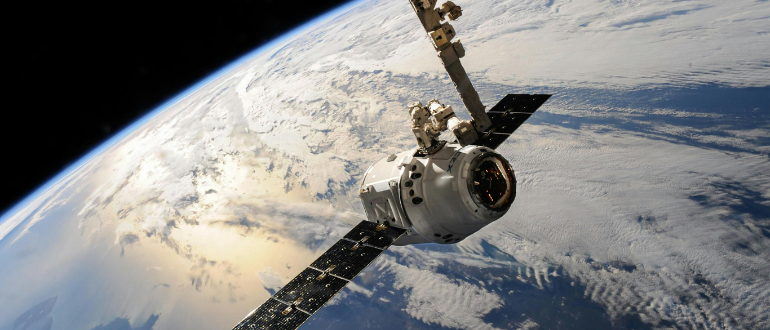
In a research project dubbed Project Suncatcher, Google engineers are exploring how to move portions of its AI infrastructure into space. The plan is based on tightly clustered constellations of roughly 80 solar-powered satellites equipped with its Trillium-generation TPU chips, linked together with ultra-high-bandwidth laser connections.
The idea is bold even by Google’s standards, but it’s grounded in a hard reality: AI’s appetite for power and land is outgrowing what many Earth-based sites can deliver.
Major Advantages
A solar panel in the optimal low-Earth orbit can generate as much as eight times the energy of a comparable panel on the ground, and do so almost continuously. That nearly round-the-clock power reduces the need for massive battery banks and avoids the battles over locations prompted by today’s data center buildouts.
Google’s engineers envision sun-synchronous orbits at about 650 km, where a cluster of satellites would sit in perpetual sunlight while circling the planet. Instead of a single monolithic platform, the system would use modular satellites flying in tight formation, each carrying TPUs and large solar arrays.
If launch prices fall below about $200 per kilogram, a threshold Google projects could be possible by the mid-2030s, the lifetime cost of launching and operating these orbital clusters could rival the energy bill of comparable data centers on Earth, according to the company’s economic modeling.
Closely Placed Orbit Path
To behave like a cohesive data center, those satellites have to talk to one another at speeds that match the internal networks of Google’s largest current facilities.
Today’s inter-satellite links typically run in the 1–100 Gbps range. Suncatcher’s designers are targeting tens of terabits per second per link, using dense wavelength-division multiplexing (DWDM) optics and multiple spatially separated beams. Hitting those numbers requires far more optical power than conventional long-haul satellite links can deliver.
One strategy that could prove feasible is to fly the satellites very close together. Google’s models describe clusters about one kilometer across, with neighboring satellites separated by only 100–200 meters as they orbit. That compressed formation boosts signal strength and allows many parallel laser beams to crisscross the cluster.
To see if the idea holds up outside of a slide deck, the team has built a bench-scale demonstrator that has already hit 1.6 Tbps of bidirectional throughput using a single optical transceiver pair. It’s an early result, but it suggests the physics are possible.
Demands of a New Era
For now, Suncatcher remains a research effort. The first real hardware test will come through a partnership with Planet Labs, which plans to fly two prototype satellites by early 2027. That mission will validate the orbital dynamics models, test optical links in space, and gather real-world radiation data on TPUs.
If those early experiments work, future constellations could scale to 81-satellite clusters and beyond, with Google hinting at eventual gigawatt-class systems and new space-optimized compute architectures that more tightly integrate power collection, compute and thermal management.
Google is hardly alone in eyeing orbital compute. Elon Musk has said SpaceX will build data centers in space; Nvidia hardware has already launched on a Starcloud satellite; former Google CEO Eric Schmidt is backing Relativity Space with an eye toward orbital infrastructure; and other startups are pitching multi-gigawatt space data centers of their own.
Critics warn that Suncatcher-style projects could accelerate a space data-center arms race, cluttering low-Earth orbit with thousands (potentially tens of thousands) of compute satellites and their debris. Astronomers already complain that proliferating constellations act to distract their fields of view, and adding dense AI clusters won’t help.
In any case, even optimistic timelines put any production-scale Suncatcher cluster a decade or more away. Launch costs must continue to fall, thermal management and ground connectivity need new engineering, and regulators have yet to weigh in on how many AI satellites is too many.
Still, Project Suncatcher reflects the era we’re in: AI demand is rising so quickly that one of the world’s largest tech companies is seriously studying moving its data centers off the planet to keep up.