
The middleware environments of large organizations have become increasingly fragmented due to platform proliferation (MQ, Kafka, Solace, RabbitMQ, etc.), making them too difficult to manage conventionally. This fragmentation creates three major problems: Operational fragmentation (inconsistent tools and blurred context), an unsustainable human workload (requiring manual, heroic efforts for provisioning and validation) and dangerous blind spots in risk and compliance due to a lack of unified audit trails and traceability. These issues lead to hidden costs such as infrastructure waste, slow delivery and long incident resolution times.
The article argues that lean operations is now a strategic necessity. This approach is defined by four principles: Unified visibility, automation and controlled self-service, resource optimization and built-in auditability.
This approach replaces reactive, high-cost operations with a governed, efficient and transparent layer. Achieving this requires a single, unified operational command plane that spans all messaging and streaming platforms, which platforms such as meshIQ Core are purpose-built to deliver.
Most organizations do not wake up one morning and decide to overhaul how they manage messaging and streaming. The shift usually begins with something far less glamorous. A delayed release because a queue was not provisioned on time, a compliance reviewer asking for audit evidence that takes days to assemble or a capacity scare on a Kafka cluster that no one saw coming.
The familiar moment in a war room, when everyone realizes the issue is happening somewhere among five different platforms and no one has the full picture, is also a common trigger. These incidents are usually dismissed as ‘part of the job’. They sit quietly in the background, tolerated but not solved. They accumulate, and eventually the realization sets in. The organization is operating its most critical digital plumbing through a system of fragmented tools, tribal knowledge, spreadsheets, screenshots and luck. The good news is that there is a way out of this.
A new operational model is emerging that allows large organizations to run their messaging and streaming estates with far more efficiency, resilience and auditability than what has been possible before. But before we get there, we need to understand how the current model became so strained.
The Reality No One Talks About: Middleware has Become too Fragmented to Manage Conventionally
If middleware were still a neat, single-platform world, most enterprises would not have a problem. However, the world changed. Acquisitions happened, and digital programs layered new technologies on top of old ones. Critical systems stayed on MQ, and cloud teams adopted native messaging.
Modern apps moved to Kafka. Integration teams added Solace, and microservices brought in RabbitMQ. Different business units made different choices at different times. Now, most organizations operate a collection of platforms that were never designed to be viewed or run together. This creates three immediate problems.
1. Operational Fragmentation
Every platform has its own way of working. Kafka has partitions and consumer groups, and MQ has channels and queues. Solace has VPNs and message spools, and cloud brokers follow their own patterns. Tools are inconsistent, naming conventions drift and monitoring is disconnected. Incident diagnostics spread across too many places, and the operational view becomes blurred. Teams spend time stitching context instead of solving problems.
2. An Unsustainable Human Workload
The people who understand this infrastructure are both scarce and overloaded. They are asked to provision objects manually, review ACLs, check configurations, investigate drift, run failovers and validate release plans. They also decode logs, triage incidents and locate the source of message failures. Repetition becomes the norm, and heroic becomes the expectation. This is not a scalable operating model for a multi-platform estate.
3. Blind Spots in Risk and Compliance
Most organizations can prove that ‘something happened’, but not necessarily ‘what happened’, ‘where it happened’ or ‘why it happened’. Regulators and audit teams want traceability, consistency and evidence. Middleware estates rarely provide it. A fragmented environment makes even basic audit questions difficult.
Who changed this configuration? Which systems participated in this transaction? Was the failure internal or external? Did messages retry, and was the security model consistent? These questions require coordinated visibility, which is difficult when data is spread across incompatible logs and systems. This gap is becoming more dangerous as regulations tighten around operational resilience.
The Hidden Costs: Waste, Delay and Defensive Operations
The consequences of this operating model are often underestimated because they are dispersed across many teams.
Infrastructure Waste
Most organizations cannot see true utilization across all messaging technologies. They over-provision Kafka storage and leave unused queues and topics running for years. They maintain oversized clusters or duplicate environments because it is easier than cleaning up. Storage, compute and licensing bills grow gradually. They are rarely challenged because no one has system-wide context.
Slow Delivery and Change Friction
Provisioning a new topic or queue should take minutes. In most enterprises, it becomes a mini-project that involves approvals, compliance reviews, manual configuration and cross-team coordination. Release cycles slow down not because of application development, but because of the plumbing beneath it.
Incident Resolution Drag
A business-critical slowdown might start on one platform and surface on another. Without visibility, teams chase symptoms. War rooms stretch into hours, and incidents that should be diagnosed quickly turn into cross-functional investigations. Mean time to recovery expands, and customer-facing systems suffer.
Compliance Overhead
Audit requests become painful exercises in log mining, screenshot gathering and Excel reconciliation and interpretation. Evidence gathering interrupts real work. Compliance results take weeks. Reviewers lose confidence in the underlying controls, and findings start appearing in reports. These costs accumulate quietly but powerfully.
A New Pressure Point: Auditability has Become Strategic
A decade ago, auditability was mostly an internal concern. Today, it is a board-level conversation. Regulators across financial services, health care, energy and the public sector now require organizations to prove the resilience and traceability of their operational systems. Messaging and streaming platforms sit at the heart of these systems. They remain some of the least auditable components in the digital landscape.
Why Auditability is so Hard Today
There is no unified audit trail. Kafka, MQ, Solace, RabbitMQ and cloud brokers produce different artefacts and correlating them manually is slow and error prone. Configuration drift is constant, and even small changes create gaps in compliance evidence. Without unified configuration intelligence, drift remains invisible. RBAC inconsistencies multiply risk. Each platform has its own security model, and proving consistency across them manually is almost impossible.
Incident reconstruction takes too long. When things go wrong, teams must recreate the past using logs from multiple systems, often with incomplete or misaligned timestamps. Compliance slows the business. Approvals, reviews and evidence take longer. This becomes a tax on every change and every release. Without built-in auditability, a middleware estate simply cannot operate at the speed the business requires.
The Shift: Lean Operations as a Strategic Imperative
Lean operations is not a slogan, nor is it about doing more with less. It is the recognition that the old operating model cannot sustain the scale, complexity and regulatory expectations of modern middleware estates. A lean model has four defining characteristics.
1. Unified Visibility
Teams need to see the entire estate in one place. This includes health, flows, dependencies, performance, lineage, configuration and security. It means actual end-to-end operational clarity, not summaries or partial views. Without this, speed and reliability are impossible.
2. Automation and Controlled Self-Service
Provisioning, validation, drift detection, ACL checks, failover routines and compliance evidence should not rely on manual effort. Automation removes friction. Policy-based self-service allows developers to work faster without increasing operational risk.
3. Resource Optimization
A lean model provides clear insight into what is oversized, underutilized, misconfigured or simply no longer needed. The result is lower infrastructure cost, more predictable capacity planning and fewer performance surprises.
4. Built-In Auditability
Audit trails must be complete, consistent and automatically captured. Configuration history must be reliable. Access models must be validated across platforms. Incident reconstruction must be fast, and evidence must be exportable without effort. Lean operations is what happens when you combine these principles. It is an operating philosophy supported by the right platform capabilities, not a tool.
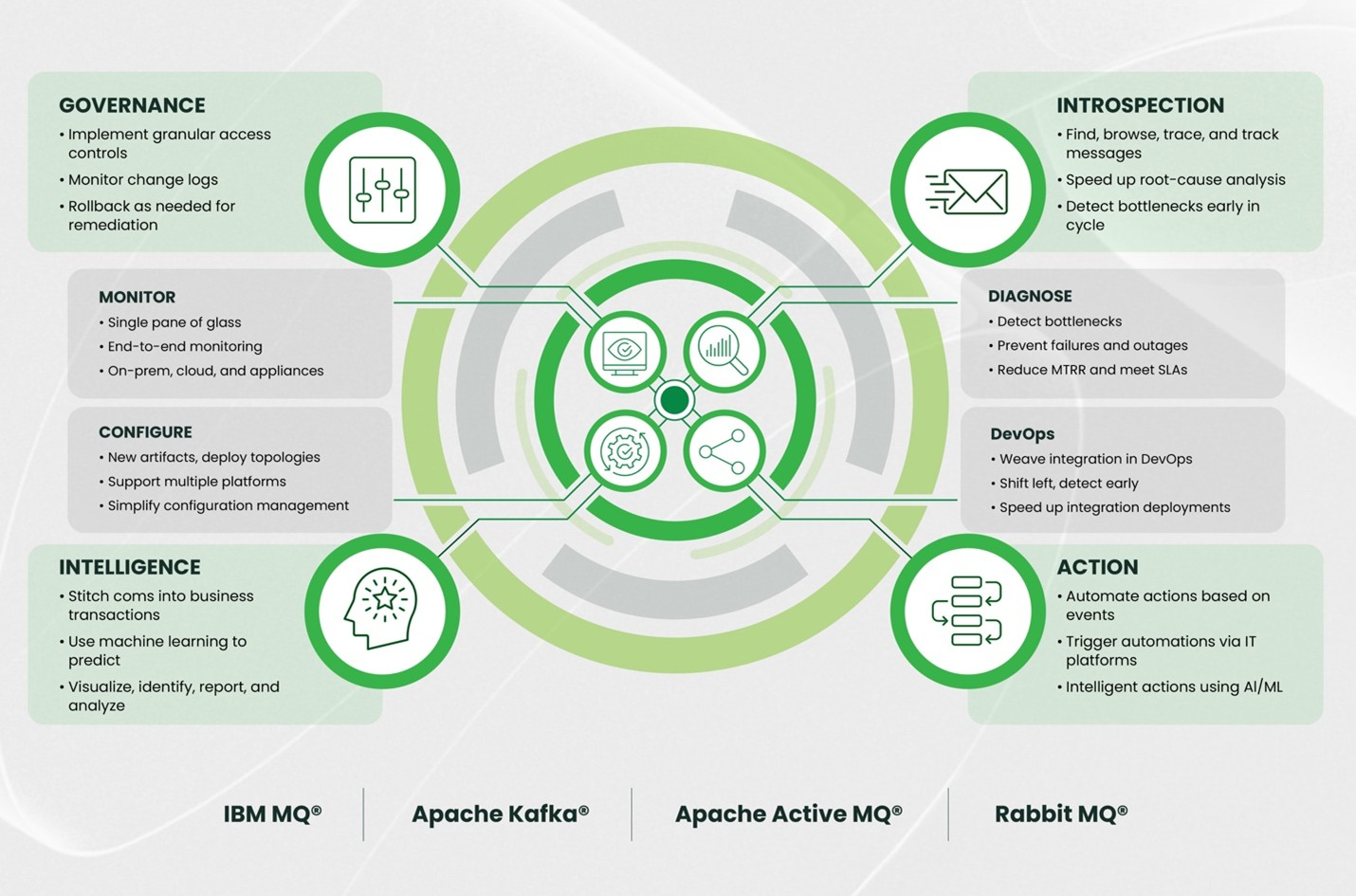
The Future State: Middleware as a Governed, Efficient and Transparent Layer
Organizations that embrace this model experience a radically different operational reality. Release cycles become smoother because provisioning and compliance do not hold them back. Outages become less frequent and shorter because teams can identify root causes quickly. Platform teams spend less time firefighting and more time improving. Infrastructure costs fall because utilization is visible and manageable. Audit requests that once took days are now delivered in minutes. Regulators gain confidence in the organization’s operational discipline.
The biggest shift, however, is cultural. Developers stop waiting for middleware teams. Middleware teams stop playing catch-up, and compliance teams stop battling for evidence. Everyone operates with the same truth, the same visibility and the same level of control. This is the future state that progressive organizations are now moving toward.
What Makes This Future State Possible?
Only a few platforms are capable of supporting the operational model described here. Most observability tools focus on metrics rather than message flows. Most monitoring solutions are tied to a single platform. Integration tools typically manage connectivity, not operations. Open-source utilities provide valuable functions but lack governance, auditability and cross-platform consistency. Cloud services help but introduce their own silos.
To reach a fully lean operating model, organizations need something that is still rare. They need a unified operational command plane that spans every messaging and streaming platform in the estate.
It must provide:
- A single operational view across all technologies
- Transaction-level lineage and flow analysis
- End-to-end audit trails
- Consistent configuration and security governance
- Automated provisioning and validation
- Self-service within guardrails
- Capacity and cost intelligence
- Multi-cloud and hybrid compatibility
- Integration with existing processes, not disruption of them
When these capabilities come together, the fragmented middleware world becomes manageable, transparent and compliant. This is the model that forward-thinking organizations are now adopting. This is exactly the model made possible by meshIQ Core.
meshIQ appears at the end of this story not because it is an afterthought, but because the logic leads naturally to it. Once you understand the operational, architectural and compliance realities of modern messaging and streaming, the need for a unified control plane becomes obvious. meshIQ is one of the few platforms purpose-built to deliver it. For various organizations, it has become the turning point from reactive, high-cost operations to a lean, governed and resilient operating model.